MY TEACHING APPROACH
German Lessons That Are
Built Around You
The name says it: I pick you up where you are, and I take you where you want to go.
That means no fixed syllabus, no lesson designed for someone else. Your level, your goals, your life — that is what your lessons are built around. Because when something is relevant to you personally, it sticks.
I have been teaching German since 2010. This page explains how I work — so you can decide whether it sounds right for you.
🎯
The starting point: your life, your topics
The best way to learn a language is through topics that actually matter to you. Not through sentences invented for a textbook. Through the things you talk about, think about, and need to communicate.
When lessons are built around your real life — your work, your situation, your questions — the language sticks. The brain makes connections that abstract exercises rarely produce.
Students who talk about what they actually care about speak more, make more mistakes, and learn faster — because they are engaged, not just going through the motions.
"Am besten find ich es immer, wenn man Deutsch lernt und irgendetwas anderes dazu."
— Daniela
🗓️
What a typical lesson looks like
Every lesson has a clear structure — but it is not rigid. It follows you.
We usually start with a short intro. You tell me what has happened since the last lesson, what you have been working on, or what is on your mind. This is not small talk. It is German practice — and it tells me exactly where you are on that particular day.
From there, the lesson moves into the main focus: grammar, speaking, writing, exam practice, or whatever your current goal is. I take notes throughout — more on that below. And I adapt as we go. If something clicks quickly, we move on. If something needs more time, we stay with it.
Lessons are goal-oriented, but they are also creative. I enjoy finding new ways to explain things and I am genuinely interested in what you bring to the session.
Lessons are goal-oriented, but they are also creative. I enjoy finding new ways to explain things and I am genuinely interested in what you bring to the session.
✏️
How I handle mistakes and corrections
I write down mistakes as they happen. Always.
While you speak, I note what you said and what the correct version is — sometimes with a direct translation if that helps. You can see this in real time, on our shared Google Doc. Nothing gets lost, nothing gets glossed over.
When I correct depends on the situation. If you are mid-sentence and in flow, I usually let you finish — interrupting at the wrong moment breaks concentration and confidence. But if a mistake needs immediate attention, I step in. The judgment call is made in the moment, every time.
The important thing is this: mistakes are not a problem. They are information. They tell me exactly what you need — and they give me the material to guide you forward.
🧩
Grammar as a system - not a table to memorise
German grammar has a reputation for being complicated. Some of that reputation is deserved — but a lot of it comes from how grammar is usually taught.
Tables. Rules to memorise. Exceptions that seem to contradict the rules. It works for some learners, but for most people, it creates the impression that German grammar is a collection of isolated facts you have to hold in your head all at once.
I see it differently. German grammar is a system — a logical one. The pieces connect. Once you understand the underlying logic, you do not need to memorise as much, because you can work things out.
A concrete example: adjective endings. Most textbooks present them as a complex grid of forms to learn. There is actually a much simpler system underneath — one that most students can understand and apply within a single lesson. It still needs practice to become automatic. But the understanding comes quickly, once it is explained the right way.
This is the approach I use across grammar topics. Not memorisation first — understanding first.
🗣️
Speaking from the very first lesson
You will speak German in your very first lesson with me. Not after a few weeks. Not once you feel ready. From the beginning.
This is deliberate. Speaking is the skill most learners are most anxious about — and the only way to reduce that anxiety is to actually speak, in a safe and supportive environment.
For students who are nervous or unsure, I take a playful approach. Humour helps. So does curiosity — finding out what interests you and building the first conversations around that. Sometimes I use structured role-plays or what I think of as detective exercises: small tasks that get you using the language without it feeling like a performance.
The goal is not perfection. The goal is to get you moving — and to show you, early on, that you can do this.
📄
Google Docs — your permanent record
Every lesson produces a shared document. This is our virtual blackboard — and it stays yours after the lesson ends.
During the lesson, I write directly into the document: corrections, vocabulary, grammar explanations, translations. You can follow along in real time. After the lesson, you can read through everything at your own pace, review what we covered, and use it as a reference for independent practice.
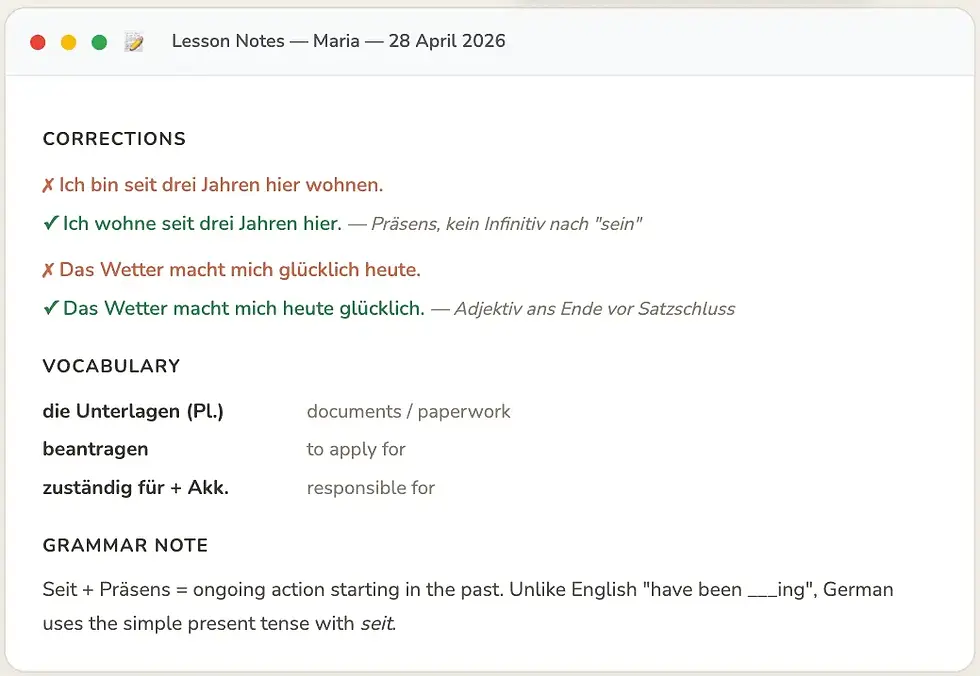
This makes the lesson more than a conversation that disappears. It becomes a resource you can return to — and a record of exactly how far you have come.
What I do differently
Six things that shape how lessons at TutorTaxi work — in practice, not just in principle.
Your topics, not a textbook's
Lessons are built around what matters to you — not around a fixed syllabus designed for a generic learner. If a topic is relevant to your life, it belongs in your lesson.
Live written feedback
I write corrections and explanations into our shared Google Doc as we go. You see the correction the moment it happens — in writing, not just spoken once and forgotten.
Grammar you understand, not just know
I explain the logic behind grammar, not just the rule. The goal is that you understand why something works — so you can apply it independently, not just repeat it.
Humour and play where it helps
Especially for anxious or reluctant speakers, a playful approach is more effective than a serious one. Learning a language should not feel like an exam.
Flexibility in the moment
No two lessons follow exactly the same path. I adapt to where you are on the day — what you need, what is working, and what needs more time.
AI-supported materials
I use modern AI tools to create personalised exercises between lessons — targeted to your level, your gaps, and your goals. Not generic exercises from a workbook.
Frequently asked questions about my teaching method
No fixed curriculum. Lessons are planned around your goals and level — with a textbook used as a reference where it helps, not as the framework for every session.
You receive access to the shared document at the start of your lessons. It is always available — you can review it at any time between sessions.
Yes. Grammar is explained as a system, not as rules to memorise. Most students find it significantly more manageable once the underlying logic is clear.